
November 2, 2026
Sussex decorator builds online trade dictionary and AI education project
We spoke to Matthias Holford, founder of H&C Cleaning and Maintenance in Sussex, about his career as a decorator and his new venture: a trade dictionary and the online tool he’s named Matt the Handy Helper.
What first drew you to painting and decorating as a teenager, and which lessons from those early years still influence how you work today?
I started working at 14, initially filling shelves in a local corner shop. At 16, I entered construction training at college, where part of the course involved experiencing different construction trades before choosing a specialism.
Initially, I had my heart set on carpentry. My dad had studied carpentry at college but hadn’t been able to complete his training following the death of his father. In a way, I thought it would be nice to follow in his footsteps and carry on something he’d started.
During the course, though, we had the opportunity to experience several different trades, including plumbing, brickwork, carpentry and painting and decorating.
It was decorating that really appealed to me.
What I liked was that decorating is the finishing trade. Other trades build, construct and install things, but we’re often the ones who come in towards the end and bring everything together. We get to make everything look good.
There’s a real satisfaction in taking something that’s unfinished, tired or neglected and transforming it into a space that people can enjoy.
That’s what drew me to decorating, and it’s something I still enjoy today.
As part of my early training, I also gained an NCFE qualification in Construction Maintenance, which gave me a broader understanding of house construction, building principles and how different trades work together. That knowledge has proved valuable throughout my career because decorating isn’t just about applying a finish. It’s also about understanding the surfaces, materials and structures you’re working with.
At 17, I began an apprenticeship with SA Plumbing and Heating, alongside the young men who would later become my business partners. The company had contracts involving MFI furniture stores and Leaders estate agents, giving us valuable experience of working on real projects.
I went on to gain my City & Guilds and NVQ Level 2 qualifications in Painting and Decorating, completing my NVQ in August 2000, and established HBH Painters & Decorators at just 18.
Those early years taught me a great deal, not just about decorating but about responsibility, dealing with customers and taking pride in my work.
One lesson that’s stayed with me is the importance of preparation. People often see the final coat of paint, but they don’t always appreciate the amount of work required to achieve a professional finish.
Perhaps most importantly, I learned that your reputation is built on doing things properly, even when nobody is watching.
That’s a principle I’ve carried with me throughout my career.
You’ve worked across domestic and commercial projects for more than 25 years. What has changed most in the trade, and what do you think decorators should hold on to?
The products, equipment and information available to decorators have changed enormously.
We have better dust extraction, improved abrasives, increasingly sophisticated coatings, specialist primers and much easier access to manufacturers’ technical information.
Technology has also changed how customers find tradespeople and how they plan their projects.
Something I’ve noticed this year is customers arriving with AI-generated designs showing exactly how they’d like their rooms to look.
The images can be incredibly convincing, but they don’t always identify an actual paint colour or manufacturer. I’ve personally visited several trade outlets trying to match colours from customers’ screens, only to encounter the same fundamental problem: a colour displayed digitally cannot be reliably reproduced as an exact physical paint match.
That’s a good example of how technology is changing the conversation between customers and decorators.
AI is becoming another tool in the tradesperson’s toolbox, whether we choose to use it ourselves or not, because customers are already using it.
But there are things we must hold on to.
Preparation, product knowledge, craftsmanship, professional judgement and taking pride in your work remain just as important today as they were when I started.
Technology should help us become better at what we do, not become a substitute for understanding the job.
What prompted you to create an online painting and decorating dictionary, and which misunderstood terms or techniques show why it’s needed?
Over the years, I’ve noticed how much specialist terminology we use in the decorating trade without necessarily thinking about whether everyone understands it.
There are differences between manufacturers, regions and countries, and sometimes people use the same term to mean slightly different things.
I wanted to create a reference that brought that terminology together in one accessible place.
The Painter & Decorator’s Dictionary is intended to explain the language of the trade, rather than replace practical instruction.
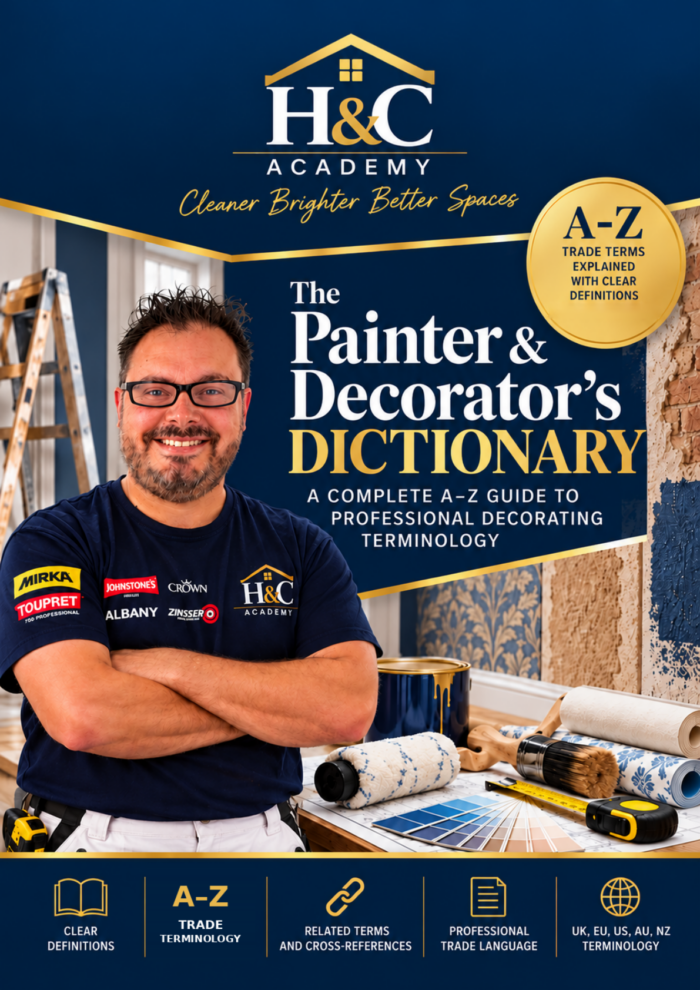
A simple example is the term “mist coat”, which is quite commonly misheard or incorrectly referred to as a “miss coat”.
It’s a small distinction, but it illustrates why understanding the correct terminology matters. A mist coat refers to an initial coat of suitably diluted paint applied to new, bare plaster, helping to establish a sound foundation for subsequent coats. The product manufacturer’s instructions should always determine the appropriate preparation and dilution.
Other terms, such as sealing, priming and stain blocking, are sometimes used interchangeably, even though they don’t necessarily describe the same process or serve the same purpose.
Understanding those differences helps people make more informed decisions and communicate more accurately.
I’m also interested in terminology used internationally, because the decorating industry is much bigger than the UK alone.
My longer-term ambition is to develop a comprehensive reference resource that apprentices, experienced decorators, suppliers and interested homeowners can all benefit from.
How are you checking the accuracy of your educational resources, and who are you developing them for: apprentices, experienced decorators or homeowners?
The training manuals I’m developing are aimed primarily at apprentices, people just starting out in the decorating trade and working professionals who want a reliable reference they can turn to when needed.
A lot of the motivation comes from my own experience of training at college. We were taught the fundamentals of painting and decorating, the practical skills and the basic knowledge needed to gain our qualifications. That gave us a good foundation, but I found there was still a gap between what we’d learned in college and what we encountered when we went out into the real world.
In a training environment, you’re learning how to carry out a particular task. But when you’re standing in front of an actual wall or substrate in somebody’s property, things aren’t always straightforward.
What happens when you discover a problem you weren’t expecting? How do you identify what’s causing it? What preparation is needed? Which product should you use, and why?
Today, there are numerous specialist products and problem-solving solutions available. Some are designed for very specific situations, while others can address several different problems. Knowing which one is appropriate, understanding its limitations and recognising when another approach is needed are all important parts of professional decorating.
That’s where I believe a comprehensive reference manual can be genuinely useful.
I want someone to be able to pick it up when they’re preparing a quotation, researching an unfamiliar surface, investigating a decorating defect or simply refreshing their knowledge. Something they can turn to at a moment’s notice rather than having to search through numerous different sources.
Part of the educational material is based on training manuals I originally produced as part of my own NVQ. I’ve been building on that foundation, incorporating the experience and knowledge I’ve gained throughout my career.
Accuracy is particularly important because the information needs to be dependable. My approach is to draw on my practical experience and training, alongside manufacturers’ technical guidance, product specifications and relevant industry standards. Where a situation requires specialist assessment, that needs to be made clear rather than encouraging someone to work beyond their competence.
The Painter & Decorator’s Dictionary is a separate but complementary project. Its purpose is to explain the terminology of the trade, including terms used internationally, rather than provide step-by-step practical instruction.
For now, the dictionary is available online only. That was the quickest way to make the information accessible and begin developing the resource further.
The training manual is a much larger undertaking. The initial concept dates back approximately five years, but it was only this year that I was able to start making substantial progress towards turning the idea into something tangible.
I’m hoping to complete the manual during 2027, as time allows alongside running H&C Cleaning and Maintenance.
Ultimately, I’d like these resources to help bridge the gap between learning the basic skills of decorating and developing the confidence and knowledge to deal with the many different situations encountered on real jobs.
They aren’t intended to replace college training, apprenticeships or manufacturers’ technical support. They’re designed to complement those things and give decorators something useful to refer back to throughout their careers.
Tell us about Matt the Handy Helper. How will the character explain practical decorating skills, and where do you draw the line between what someone can learn online and what needs hands-on teaching?
Matt the Handy Helper is a digital character I’ve developed as part of H&C’s educational plans.
The idea is to make technical information more approachable and engaging, particularly for people who might find traditional manuals difficult to follow.
I envisage Matt explaining decorating terminology, tools, materials, common problems and basic maintenance concepts through short videos and other digital content.
There is also potential to make information accessible in different languages.
But Matt’s role extends beyond decorating education.
He’ll also help introduce and showcase the wider services and projects being developed through H&C, including cleaning, property maintenance, kitchens and bathrooms, colour and design, and other initiatives as they develop.
I want Matt to become a recognisable, approachable character who can help communicate both practical knowledge and what H&C is doing as a business.
At the same time, I think it’s important to distinguish between explaining a skill and being competent to carry it out.
A video can show someone what a tool is used for, explain a preparation process or help them understand why a particular product is specified.
What it cannot do is replace practical experience, supervised training or the judgement needed when something unexpected happens on a job.
Some work also involves significant safety considerations and requires properly trained professionals.
My aim isn’t to suggest that watching a few videos makes someone a qualified decorator. It’s to support learning, encourage curiosity and help people understand the trade more clearly.
If these resources inspire someone to pursue proper training or help an existing tradesperson improve their knowledge, that’s a worthwhile result.
You recently took part in filming for Zinsser’s Mark of a Pro campaign. What did you want to communicate about professional decorating, and what role has manufacturers’ technical advice played in your own work?
Being invited to take part in Zinsser’s Mark of a Pro campaign was a significant opportunity for me.
I’ve been involved in decorating for most of my working life, so having the chance to reflect on that experience and discuss what professionalism means was something I appreciated.
One thing I feel quite strongly about is that painting and decorating is often misrepresented as an easy trade.
That attitude really doesn’t wash with me.
Of course, almost anybody can pick up a brush or roller and put paint on a wall. But there’s a world of difference between applying paint and being a professional painter and decorator.
It’s a skilled trade that requires knowledge, experience, patience and an understanding of surfaces, preparation, materials and application techniques.
And to do it day in, day out, I believe you need a genuine passion for the work. You have to enjoy what you do, take pride in the transformation and get satisfaction from seeing the finished result.
Just as importantly, you need to look after your customers. You’re often working in people’s homes or businesses, and they’re trusting you with their property and their money. That responsibility shouldn’t be taken lightly.
For me, the mark of a professional is doing the right things the right way, even when nobody is watching.
It’s about taking responsibility for your work, understanding the materials you’re using and not cutting corners simply because a customer might never know.
I’m also at a stage in my career where I’m thinking increasingly about the next generation of decorators and how I can pass on what I’ve learned.
Manufacturers have an important role in that.
Zinsser, for example, offers technical support, including site visits and product specifications. That kind of guidance can be invaluable when dealing with difficult substrates, staining, adhesion problems or unusual situations.
A good professional shouldn’t be afraid to ask for technical advice. Knowing when to consult the manufacturer is part of doing the job properly.
I hope the filming communicates that professionalism isn’t just about how good the finished room looks. It’s about the knowledge, preparation, decisions and standards behind it.
But above all, I hope it reminds people that decorating is a skilled profession, carried out by people who genuinely care about their craft and the customers they work for.
How do you balance earning a living through hands-on work with developing educational projects, and what would you most like those projects to achieve for the next generation of decorators?
That’s probably one of the biggest challenges.
Balancing work with family responsibilities is something I’ve had to do throughout my career.
There was a period when I worked full-time night shifts at Tesco to support my wife while she trained to become a paediatric nurse.
However, I never completely stepped away from painting and decorating. I continued undertaking decorating work part-time during the day, maintaining my practical skills and the professional relationships I’d established with the people I’d originally trained alongside.
Those relationships were particularly valuable. We’d started out in the trade together, and staying connected meant I remained involved in the industry, sharing knowledge and keeping up with developments.
In 2018, I returned to decorating full-time and established H&C Cleaning and Maintenance, building on the experience, skills and relationships I’d maintained throughout those years.
Today, the day-to-day work of running a business has to come first. There are customers to look after, quotations to prepare and jobs to complete.
The educational projects have developed alongside that work, often in the time I have available outside normal working hours.
I’m gradually looking at ways of building the business so that more of the everyday work can be undertaken by a wider team, giving me additional time to develop the publications, training resources and digital projects.
Ultimately, I don’t want the knowledge I’ve gained over the years to remain solely in my head.
I’ve benefited from training, experience, manufacturers’ advice and the knowledge of other tradespeople throughout my career.
I’d like to contribute something useful in return.
I also think the next generation will work in a very different environment, particularly with the rapid development of artificial intelligence.
AI is already becoming part of everyday life, and I’m seeing that first-hand with customers.
People are increasingly using AI to visualise their decorating projects, experiment with different colour schemes and see what their rooms could look like before any work begins. They’re also using it to research decorating methods, understand what a professional should be doing and form expectations about the work involved.
That’s changing the relationship between the customer and the decorator.
I actually think AI is helping to make professionals more accountable to the standards they claim to uphold, and that’s not necessarily a bad thing.
Customers now have much easier access to information about preparation, products, application methods and what constitutes good professional practice. They can ask more informed questions and better understand why certain work is necessary.
Of course, AI doesn’t always provide accurate information, and every property presents its own circumstances. That’s where a professional’s knowledge and experience become essential.
But I believe that if you’re genuinely working to the standards you promote, you should be comfortable explaining your methods, justifying your recommendations and being questioned about your work.
Professionalism isn’t simply about telling customers you know what you’re doing. It’s about being able to demonstrate it.
I’ve had several jobs this year where customers have shown me AI-generated images of their rooms and asked me to reproduce the colours.
The difficulty is that the AI has generated a visual representation of a colour, not necessarily an actual paint colour available from a manufacturer.
Trying to match that colour exactly is virtually impossible because there are so many contributing factors. The screen displaying the image, its brightness and colour settings, the lighting and shadows within the AI-generated picture, and the actual lighting conditions in the customer’s property can all affect how a colour appears.
Then there are the real-world considerations of the surface being painted, the paint’s finish and how the colour changes under different lighting throughout the day.
I’ve even visited trade suppliers to investigate possible matches, but ultimately you cannot guarantee a 100% accurate reproduction of a colour simply from an AI-generated image on a screen.
That’s not necessarily a criticism of AI. It’s a recognition of the difference between creating a convincing digital image and producing a physical result in the real world.
And I think it’s an important distinction for both customers and tradespeople to understand.
AI can be a fantastic tool for generating ideas and helping customers communicate what they’re hoping to achieve. But a professional decorator still needs to assess the actual property, identify any problems, select suitable materials and explain what’s realistically achievable.
In many ways, AI is becoming another tool in the tradesperson’s toolbox, whether we choose to use it ourselves or not, because our customers are already using it.
For the next generation of decorators, I believe understanding these technologies will become increasingly important alongside traditional practical skills.
They’ll need to know not only how to carry out the work properly, but also how to interpret digital designs, assess information generated by AI and communicate clearly with customers about its limitations.
That’s part of what I’d like my educational projects to help with: bridging the gap between traditional craftsmanship, practical knowledge and the technologies that are changing our industry.
If the dictionary, Matt the Handy Helper and the wider H&C educational resources can help people develop their skills, improve their understanding and take pride in doing a job properly, I’ll consider that a worthwhile achievement.